


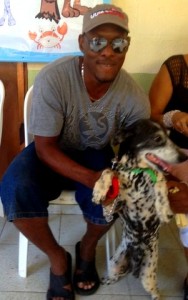
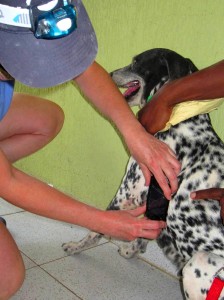
 “Pecas”, a 13 year old female dog, arrived at our most recent spay/neuter and animal outreach clinic held last month in San Andres Island. Overall she was in good shape and generally well looked after. However, over her lifetime she had had countless litters and was still cycling in her old age. For fear that she would accidentally become pregnant again, her owner wanted to have “Pecas” spayed. While this was not an uncommon scenario, what made this case especially unique was that “Pecas” had recently been diagnosed heartworm positive by a local veterinarian. She was also discovered to have a fast heart rate and murmur. It was claimed that because of this condition she would not likely survive the surgery.
Our team spoke at length to the owner and advised on the ideal way to get “Pecas” spayed – with gas anesthesia and more monitoring equipment – luxuries that were not present at our field condition clinic. Unfortunately this was not a viable option either as such equipment did not exist on the island for animals and the owner could not afford to fly “Pecas” to the Colombian mainland for the procedure.
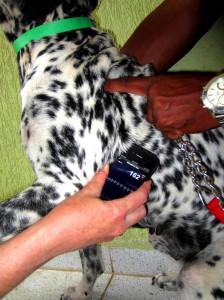
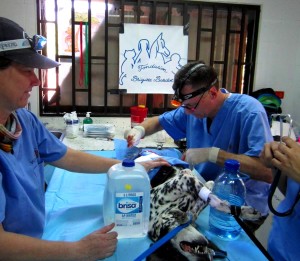
After much consideration and being made aware of the risks involved, “Pecas” owner elected to have the surgery done as he believed it was in her best interest. Even though we did not have a fancy surgical suite, we did have on hand an AliveCor heart monitor to run an EKG as well as monitor “Pecas” heart rate. World Vets veteran Dr. Michelle Ward monitored “Pecas” with the AliveCor while Dr. Barry Nichols performed the surgery. Upon her return to the United States, Dr. Ward had the EKG analyzed, which confirmed that there were no EKG abnormalities. We would like to thank Antech for donating their services in the EKG analysis.
We are happy to report that “Pecas” recovered very smoothly from the anesthesia and had been doing great following her discharge from the clinic. In the end, the owner was very happy that he had decided to do the surgery and that World Vets had come to the island making her surgery impossible to possible.
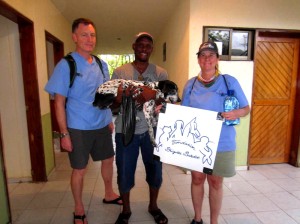
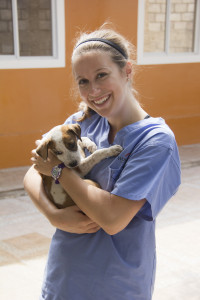 During the whole month of March, World Vets operated its I
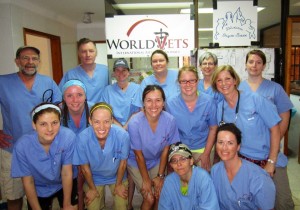 During Semana Santa (Holy Week), World Vets had a veterinary team on the Caribbean Island of San Andres Island. We provided a large scale spay/neuter clinic and also attended health consultations. All services were provided free of charge. The island currently lacks regular veterinary services for small animals and our clinic, in collaboration with the island’s department of health, saw up to 300 animals and performed 198 surgeries in just a couple of days.
 During the month of March World Vets sent a veterinary team to the Otavalo region of Ecuador in support of our small animal project. We have been working in this region for the past four years with local animal welfare group PAE Ibarra to control the street as well as owned small animal population. We thank Fondation Brigitte Bardot for their continual support of this project as well as our volunteers that put forth an outstanding effort which resulted in 229 free spay/neuter surgeries being performed.
 We have just completed a successful veterinary campaign Roatan, Honduras. Our veterinary team provided not only free spay/neuter services but an animal outreach clinic which provided free health consultations and preventative health treatments to small animals. During our visit, we performed 160 surgeries and treated over 350 animals. One of our patients was a dog that jumped off a roof but was lucky enough to receive special emergency surgery from our outstanding volunteers.

